STYLE ADVICE • 6-MINUTE READ
How to Layer Necklaces Over 50
for an Effortless Quiet Luxury Look
Layered necklaces are the quiet-luxury shortcut — but the difference between “expensive” and “tangled” comes down to five small rules. Here’s the buyer’s playbook for getting it right every time.
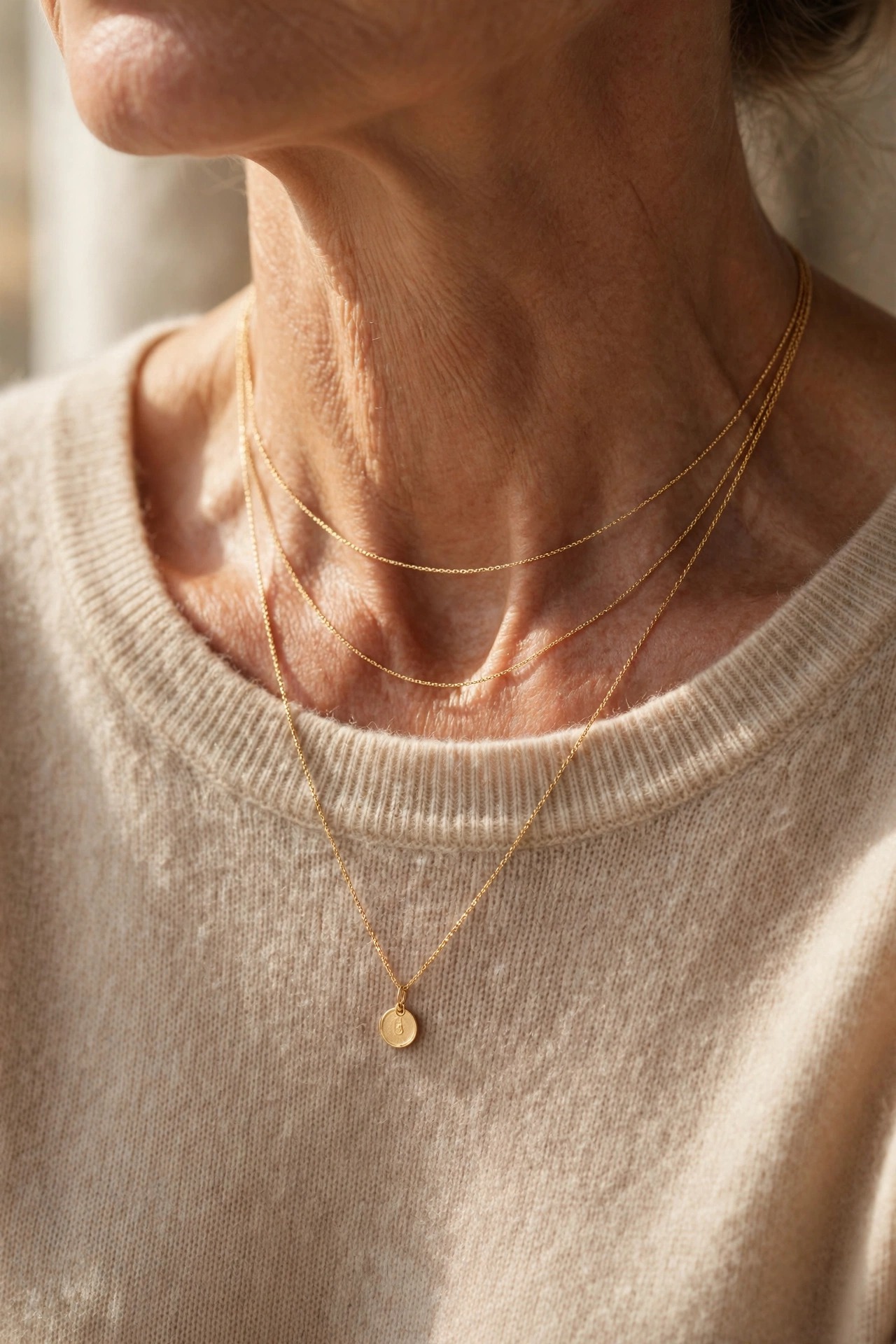
Three thin chains, one small pendant, zero fuss. This is what quiet luxury looks like at the neckline.
Every decade has its jewelry mistakes. The eighties gave us power earrings the size of coasters. The nineties gave us the single strand of pearls worn with a sense of duty. And somewhere in the last few years, “necklace stacking” became a thing — and most of the advice was written for twenty-five-year-olds with five identical chains and no opinion.
But here’s what I know from thirty years of buying: a well-layered necklace is the single fastest way to look expensive after 50. It frames the face, catches the light near your skin, and turns a plain cashmere sweater into an outfit. The catch? At our age, the margin between “effortless” and “cluttered” is thin — about two inches, in fact. These are the seven rules I give every client who wants the look.
| # | The rule | Why it works after 50 | The payoff |
|---|---|---|---|
| 1 | The 2-inch rule | Stops chains sitting on top of each other | Every necklace reads as its own piece |
| 2 | Mix metals deliberately | Reads as collected, not confused | The “I’ve travelled” elegance |
| 3 | One pendant, one hero | Gives the eye somewhere to land | Instant focal point |
| 4 | Match the neckline | Chain and collar in conversation, not combat | Every top gets an upgrade |
| 5 | Vary the texture | Interest without more “stuff” | Depth that photographs beautifully |
| 6 | Modernize the pearls | Updates the classic everyone already owns | Heritage, not heirloom-museum |
| 7 | One statement, one whisper | Maximum impact, zero noise | Drama without the drama |
1. The 2-Inch Rule: Lengths That Never Fight
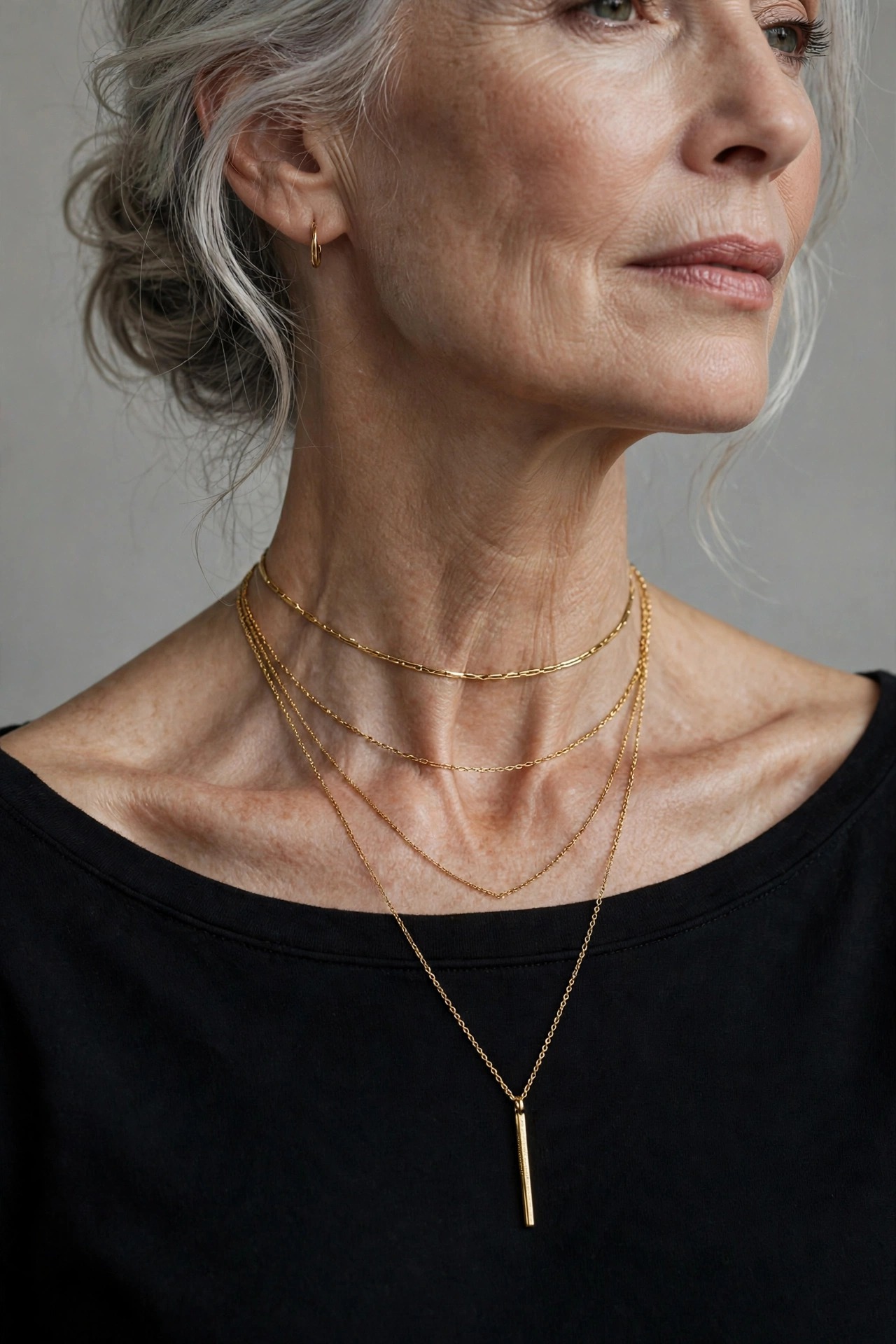
16, 18, 20 — three lengths, two inches apart, and not one of them is fighting the others.
Ninety percent of tangled-looking stacks fail for one reason: the chains are all the same length, so they pile up into a knotted-looking clump at one spot on your chest. The fix is arithmetic. Choose chains that sit at least two inches apart — say 16″, 18″, and 20″ — and each piece hangs in its own lane.
Don’t know your current chains’ lengths? Lay them flat and measure. Or stand in front of a mirror and use a necklace extender (more on those in rule 8) to nudge one chain longer until the spacing looks right. A buyer’s confession: I have owned the same three gold chains for a decade. I just changed the lengths, and suddenly they looked like a deliberate stack instead of a jewellery-box accident.
2. Mix Metals Like You Mean It

Rose gold, yellow gold, silver — together they say “collected over a lifetime,” not “mismatched.”
We were raised on a rule: pick a metal and marry it. Break up with that rule. Mixed metals are the quiet-luxury signature precisely because they suggest a life — the silver chain from the trip, the rose gold from the decade everyone wore it, the yellow gold that never left.
The trick is proportion: keep roughly 70% of your stack in one dominant metal (gold is the classic), and let the other metals play supporting roles. And repeat — if you mix metals at your neck, echo it with one mixed-metal ring or bracelet so it reads as intention, not indecision. The one thing that looks accidental is two metals split 50/50 with nothing tying them together. Pick a leader; let the rest follow.
3. Let One Pendant Be the Star

Every stack needs a leading lady. Give her the longest chain and the best seat.
A stack of nothing-but-chains can look pretty — but it can also look unfinished, like you forgot the point. One pendant gives the eye a place to land and the whole stack a reason to exist. A locket, a coin, a single pearl drop, a tiny stone in your birthstone — anything with a little weight and a little meaning.
Placement matters: the pendant should hang on the longest chain, sitting lower than everything else, roughly at or just below the sternum. Too high and it crowds the chains above it; too low and it disappears under the neckline. And keep the other layers simple when the pendant is decorative — a textured pendant plus two textured chains is three people talking at once. Let the star have the floor.
4. Match the Necklace to the Neckline

The scoop neckline invited the shorter layers in. The chains said thank you and sat exactly where they were told.
A necklace doesn’t exist in a vacuum — it exists in a negotiation with your neckline. The golden rule: the shortest chain should sit either above or below the neckline’s edge, never right on it. A chain that lands exactly on a collar seam looks like it lost a fight with your shirt.
| Neckline | Best stack | Why it works |
|---|---|---|
| V-neck | A pendant that echoes the V + one short chain | The lines rhyme instead of crossing |
| Scoop / boat neck | Shorter layered chains (14–18″) | They fill the open space the neckline reveals |
| Crew / high neck | Longer chains only (20″+, over the fabric) | Short chains get swallowed — go long and visible |
| Button-down collar | One fine chain inside the collar, pendant below | Polished without competing with the collar |
| Strapless / off-shoulder | Shorter statement layers close to the throat | The bare canvas invites bolder jewellery |
If you take one thing from this whole article, take this: get dressed first, then choose the necklaces. Build the stack for the neckline you’re actually wearing, not the one you wish you were wearing. Two minutes of matching saves you from the all-day feeling that something is “off” and you can’t name it.
5. Play With Texture, Not Just Color
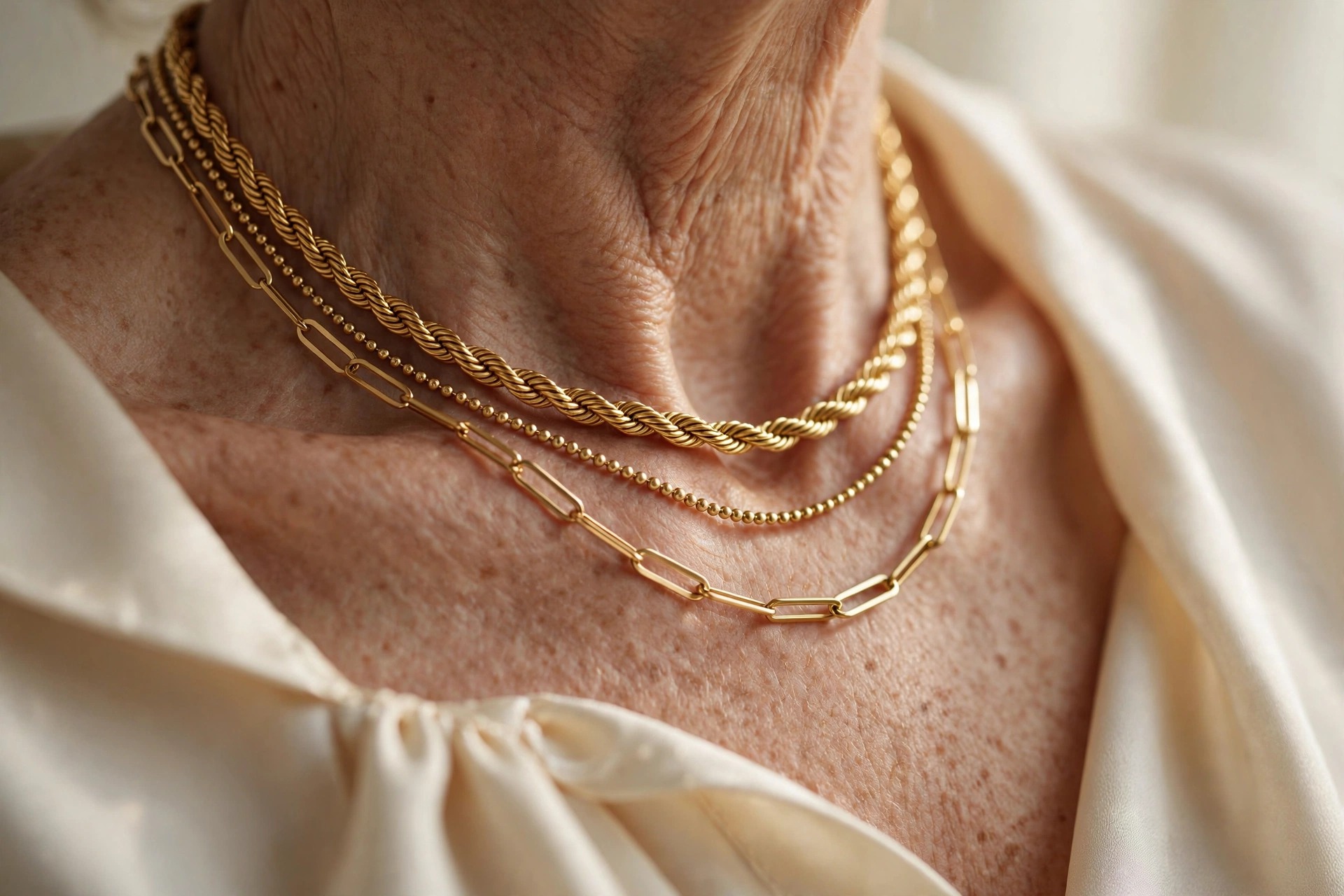
Rope, beads, paperclip — three textures of the same gold. The eye stays interested without a single extra color.
Beginners stack by color: all gold, all silver. Intermediates stack by metal. But the women who make you stare at their neckline in the checkout line? They stack by texture. A twisted rope chain next to tiny beads next to a flat paperclip link — all the same gold — creates a richness that three identical chains never will.
This is the cheapest upgrade in the whole article because it uses what you already own. Pull out every chain you have and sort them by texture: smooth, twisted, beaded, link, rope. Now rebuild your stack picking one from each column. Same metals you always wore — completely different woman in the mirror. Texture is the quiet-luxury secret because it reads as expensive the way a fabric’s weave does: you feel the quality before you can name it.
6. The Pearl Revival — Done the Modern Way

The pearls never left. They were just waiting for someone to stop wearing them apologetically.
Somewhere along the way, pearls got filed under “funeral and mother-of-the-bride.” Unfair — and fixable. The modern pearl stack isn’t one perfect strand worn with reverence; it’s pearls treated casually: two or three strands at different lengths, maybe mixed sizes, worn with a turtleneck and jeans like they cost nothing.
The move that updates them instantly: layer your classic pearl strand with a fine gold chain. The gold breaks the formality; the pearls keep the grace. And skip the matchy pearl earrings-and-necklace set from 1987 — one pearl element at a time is the modern ratio. Your grandmother’s pearls, your rules. She’d approve; she was probably bolder than you think.
7. One Statement, One Whisper

One voice, loud. One voice, barely there. That’s the whole composition.
Some days you want more than delicate. Fine — but the layered version of “bold” still needs discipline. The formula: one statement piece plus one whisper-thin chain, and nothing else. The bold necklace does the talking; the fine chain is the pause between sentences that makes the talking land.
What counts as a statement after 50? Sculptural gold, a wide collar, a substantial pendant, an Art Deco bar — anything with presence and clean lines. What doesn’t: anything spiky, anything with more than three dangling charms, anything that jingles when you turn your head. (Jewelry should never announce you before you arrive.) Wear the statement at collarbone length where it frames your face, and let the whisper sit two inches below it. Two pieces, one sentence, period.
| Do this | Not this |
|---|---|
| Space chains 2+ inches apart | Three chains all landing in the same spot |
| Mix metals with one dominant metal (~70/30) | One lonely silver chain lost in a gold stack |
| One pendant as the focal point | Three pendants competing like rival sopranos |
| Match the stack to the neckline | A chain landing exactly on the collar seam |
| Vary textures within one metal | Five identical chains from the same set |
| Layer pearls casually, at varied lengths | The full matched pearl “set” with earrings |
| One statement + one whisper-thin chain | Two statement pieces shouting over each other |
| Use extenders and detangler clasps | Suffering the daily knot-untying ritual |
8. The Finish: Anti-Tangle Tricks Worth Their Weight

The last look in the mirror isn’t vanity. It’s quality control — and it takes eleven seconds.
All the styling rules in the world won’t help if your stack twists into a single braided rope by noon. Three small investments solve it: necklace extenders (a 2-inch extender turns any chain into the length you actually need), a layering clasp / detangler (one clasp that holds two or three chains at fixed spacing — the single best ten dollars in jewelry), and different chain weights (a heavier chain below a lighter one pulls everything straight).
Putting them on matters too: fasten the shortest chain first, working downward, and give each layer a gentle tug to settle it before adding the next. When you travel, thread each necklace through a drinking straw and fasten the clasp — it sounds ridiculous and works perfectly. These aren’t glamorous tips. They’re the difference between a stack that looks deliberate at 9 a.m. and still looks deliberate at 9 p.m.
Can I wear layered necklaces every day, or is it too much?
Every day — that’s the whole point. A simple two-chain stack (one short, one pendant) is easier than choosing earrings and makes a plain sweater look considered. Save the three-layer compositions for days you want the extra polish. Quiet luxury is a daily habit, not an occasion.
I have a short neck. Will layering make it look shorter?
Only if every chain lands in the same place. Keep your shortest chain at 16 inches or longer so it sits below the throat, and let the longest one draw the eye downward with a pendant. A V-shaped arrangement (shorter at the sides, longer in the middle) actually lengthens the neck visually. Avoid chokers if this is your concern — they do the opposite.
Are layered necklaces appropriate for a woman in her 60s and 70s?
Completely — when they’re edited. The rules in this article exist precisely because restraint reads as elegance at our age. Two or three refined layers will always look right; five chunky ones will read as costume. Age doesn’t limit the look; clutter does.
How do I stop my necklaces from tangling during the day?
Use a multi-strand layering clasp that holds each chain at a fixed distance — it eliminates 90% of tangling. Also vary the chain weights (heavier below, lighter above) and keep at least two inches between lengths. Chains tangle when they’re the same length and weight, fighting for the same space.
Should my necklaces match my earrings?
Coordinate, don’t match. If your stack is gold and delicate, wear gold earrings in a similar spirit — small hoops, a stud, a short drop. The matchy full “set” (identical necklace and earrings from one box) is what dates a look. Think family resemblance, not identical twins.
What’s the one piece to buy if I own nothing layered?
A 20-inch fine gold chain with a small pendant you love — a coin, a locket, a stone. Wear it alone for a week. Then add a shorter 16-inch chain you probably already own. Congratulations: you now have a stack, and you spent nothing. Build from there.
The real secret? Layered necklaces aren’t about the necklaces. They’re about the message: I paid attention. At an age when the world starts assuming you’ve stopped noticing things — trends, details, yourself — a deliberate little composition at your throat says otherwise. It says you still curate. You still choose. You still know exactly what you’re doing.
So open the jewelry box tonight. Pull out the chains you already own, measure the lengths, pick your pendant, and build one stack for tomorrow’s neckline. Two inches apart, one star, textures that talk to each other. Then walk out the door looking like the most quietly expensive woman in the room — because you decided to be.