
STYLE ADVICE • 11-MINUTE READ
I Moved Into a Retirement Community at 78:
11 Honest Truths About Life There
The glossy brochure promised resort living. What I actually got was messier, funnier, and — honestly — better. A former fashion buyer tells you everything the tour guide skips.
The front steps of my new life. I cried the day I walked in — and I’ve laughed more here than anywhere else in twenty years. (Photo: Balibili)
I told exactly three people I was considering a retirement community. My best friend gasped. My daughter went quiet. And my neighbor said, “Honey, you’re not that old.” Reader, I was 77.
A year later I moved in — a one-bedroom with a kitchen I actually cook in, a view of the courtyard garden, and a closet a third the size of the one I left behind. It was the most terrifying and the most sensible thing I’ve done in a decade. And almost nothing about it matched the brochure.
After thirty years as a fashion buyer, I know how marketing works: the pretty pictures are real, they just leave out the parts that matter. So here’s the full, honest version — the eleven truths nobody tells you on the tour, written by a woman who lived them.
What I Expected vs. What I Found
| What the brochure implied | What actually happened |
|---|---|
| Resort-style luxury, daily bliss | Comfortable, friendly, occasionally tedious — like real life, minus the roof leaks |
| Instant friends everywhere | Instant acquaintances everywhere; real friends take about three months |
| I’d feel old moving in | I felt younger within weeks — nobody here is impressed by your age |
| Saying goodbye to independence | Trading maintenance for freedom. I haven’t unclogged a drain in a year and I do not miss it |
| Quiet, boring days | My calendar is fuller than my working years — but everything on it is optional |
1. You Don’t Move In for the Amenities — You Move In for the People Who Notice

Breakfast club: the table where your absence gets noticed before your presence does. (Photo: Balibili)
Here’s the truth the glossy photos can’t sell: the swimming pool is lovely, but what keeps you alive here is that someone notices when you skip breakfast. When I had the flu in month four, three different women knocked on my door before noon — not because we’re best friends, but because my chair was empty and that meant something.
In my old house, I could go three days without speaking to anyone. Nobody checked. That’s the quietest danger of aging alone — not a fall, not a scam call, but the slow fade into a life where your absence changes nothing. In a community, your absence is an event. People ask. People bring soup. That single difference is worth more than every amenity in the brochure.
The payoff: you become visible again. At 78, being visible — truly seen, daily — is the most valuable currency there is.
2. Downsizing Your Closet Will Wreck You — Then Free You

The great closet reckoning: three decades of “just in case” goes in the box. (Photo: Balibili)
My new closet holds about a third of what my old one did, and the sorting nearly did me in. The black dress from my daughter’s wedding. The silk blouse I wore to close my first real deal. A coat that still smells faintly of a perfume they discontinued in 2004. Every hanger was a memory arguing for its life.
Here’s the buyer in me speaking: keep the pieces that tell your story, not the costumes from roles you’ve retired. I kept the wedding dress (my story), the camel coat I wear constantly (my life), and exactly two “someday” items. Everything else went to the charity shop down the street — and I checked that week that a girl named Priya got the silk blouse. She sent me a photo wearing it to an interview. That blouse has a better life than I gave it in fifteen years.
The payoff: getting dressed is suddenly easy. Fewer clothes, all beloved, nothing to forgive. Every morning I open that smaller closet and feel rich.
3. The Dining Room Has a Dress Code Nobody Writes Down

Night three, I finally read the room: dinner is an occasion, and occasion dressing is a kindness. (Photo: Balibili)
My first night, I walked into the dining room in sweatpants. Nobody said a word — which is how I knew I’d committed a crime. By night three I’d decoded it: lunch is come-as-you-are, but dinner is an occasion. Not formal — the woman at table six wears spectacular earrings with jeans — but intentional.
There are unwritten rules everywhere, and dinner dress is the fastest one to learn. Nobody will tell you; you’ll just feel the stares on your gym shoes while everyone else is in loafers. My advice: for the first week, overdress slightly. A nice sweater, real trousers, a touch of lipstick. You’ll blend in, and more importantly, you’ll feel like you belong — which is half the battle of any new beginning.
The payoff: I started dressing for dinner and ended up dressing better than I had in a decade. There’s something about being seen every evening that puts the pride back in your presentation.
4. The Schedule Will Own You — and You’ll Love It

Tuesday, 9 a.m.: chair yoga. It took six weeks before I stopped laughing at myself — now I never miss it. (Photo: Balibili)
“Independent living” suggests you do whatever you want. In practice, the building runs on a rhythm — breakfast service, classes, outings, happy hour — and within a month you realize your week has a shape again. Water aerobics at ten. The book club on Thursdays. The shuttle to the farmers’ market Saturday morning.
I expected to resent it. Instead, structure turned out to be the secret luxury I didn’t know I was missing. In my house, days blurred into a long gray afternoon of errands and television. Here, the day has punctuation. And the miracle: everything is optional. The schedule is a buffet, not a boss. On days I want silence, I skip everything and nobody judges — they just ask if I’m alright tomorrow.
The payoff: rhythm without obligation. It’s the work calendar’s grown-up, kinder cousin — all the shape, none of the dread.
5. Your Children Will Grieve the Family Home Longer Than You Will

She cried over the kitchen table. I’d already said goodbye to it three months earlier. (Photo: Balibili)
I was ready to leave the house. My daughter was not. She cried over the kitchen table where her kids did homework, the tree in the backyard, the wall with the pencil marks measuring their heights. I had to comfort my own child about a decision that was mine to make.
Here’s what I wish someone had told me: children grieve the container of their childhood, and they confuse that with grieving your choice. Let them grieve — it’s real — but don’t let their tears rewrite your decision. Once my daughter saw my apartment, met my breakfast-club friends, and watched me walk to dinner instead of microwaving soup alone, her grief turned into something she never expected: relief. She’d been worrying about me for years.
The payoff: this move is the greatest gift you can give your children — the gift of not having to worry. Say that to them out loud. It helps more than you know.
6. The Activities Calendar Is a Buffet, Not a Job Description
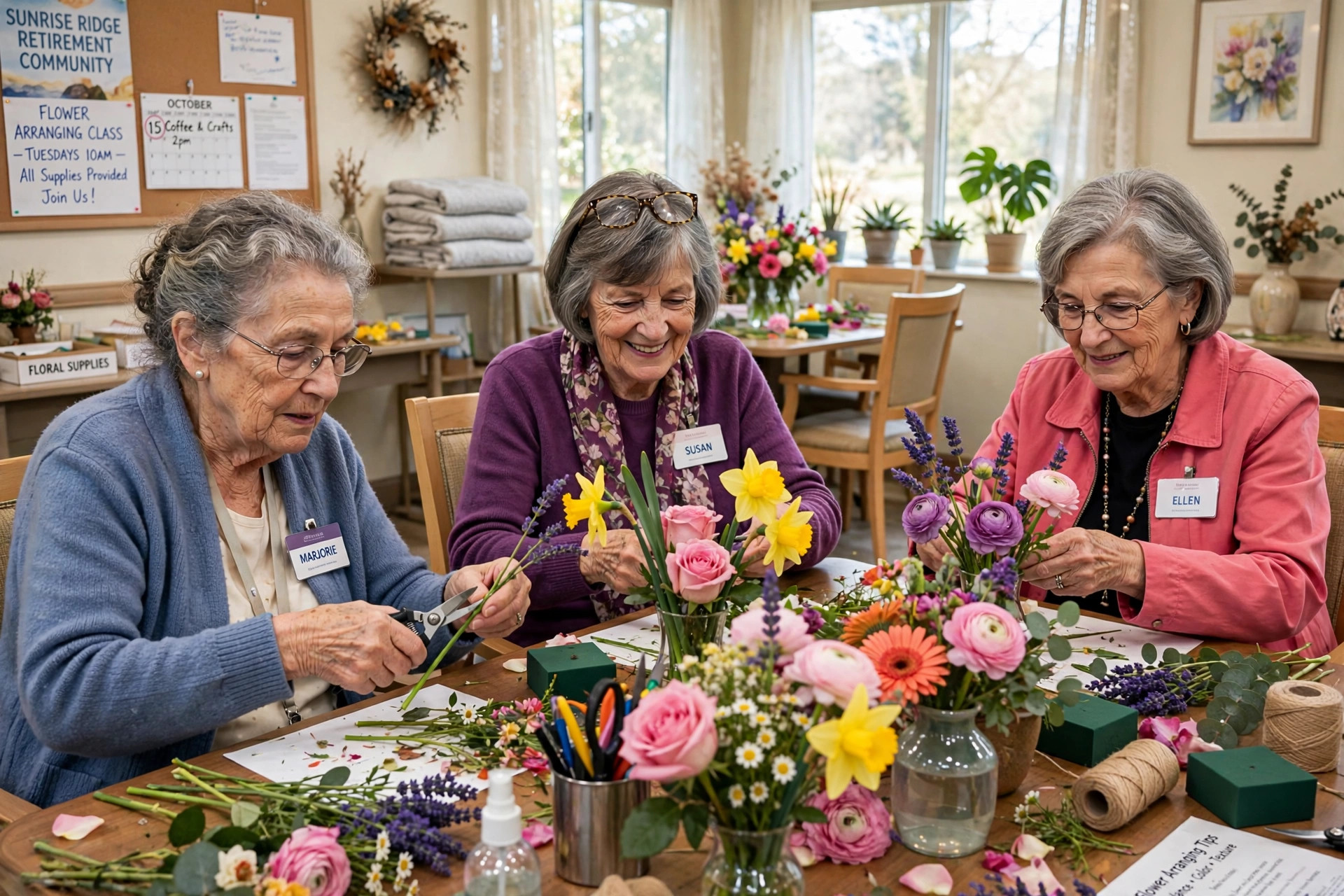
Flower arranging: one of my two chosen joys. The line dancing remains a spectator sport. (Photo: Balibili)
New residents make the same mistake I did: they treat the activities calendar like a syllabus. Bridge, bingo, choir, watercolors, current-events discussion, the walking group, the wine club — I signed up for everything in week one and was exhausted, overstimulated, and quietly miserable by week three.
A woman named Ruth, 89 and sharper than all of us, gave me the advice I now pass to every newcomer: pick two things and do them well. Skip the rest without guilt. My two: the flower-arranging class and the Thursday book club. That’s it. I audit the wine club occasionally and I watch line dancing like it’s theater. I am happier than the woman down the hall who runs a full schedule and knows everyone’s name but no one’s story.
The payoff: depth beats breadth, at 78 like at 28. Two real commitments will give you more friendship than ten casual ones.
7. The Money Math Isn’t Scary — It’s Just Never Explained Twice

The money meeting: ask every “silly” question twice. It’s your money and your future. (Photo: Balibili)
Let’s talk numbers, because the brochure won’t. Most communities charge an entrance fee (buy-in) plus a monthly fee. In my area, buy-ins run anywhere from a modest five figures to the price of a small house, and monthly fees from a couple thousand up depending on the apartment size and care level. What’s included varies wildly: mine covers one meal daily, all utilities, housekeeping, maintenance, and a mountain of activities. It does not cover my car, my phone, or my stubborn refusal to stop buying scarves.
The honest math: add up what your house actually costs — mortgage or taxes, insurance, utilities, maintenance, repairs, lawn care, that plumber who now knows your birthday — and compare it to the monthly fee. For me, the community was barely more expensive than the house. For many of my neighbors, it was less. And the refundable portion of the buy-in (ask about this specifically — some contracts refund 50–90% to your estate) changes the equation entirely.
The payoff: do the real math, in writing, before you sign. The peace of mind is worth the awkward questions. Ask every “silly” one twice.
8. Gossip Travels Faster Than the Elevator

Confide carefully in month one. The cafe grapevine has excellent hearing and zero confidentiality. (Photo: Balibili)
A community of three hundred adults who eat together, take classes together, and have endless time on their hands is a gossip ecosystem of stunning efficiency. By my second week, I knew who was feuding with whom, whose daughter never visits, and which table you don’t sit at unless invited. I learned this last one the hard way.
Here’s my rule, borrowed from thirty years of buying offices: be warm to everyone, be confidential with almost no one — at least for the first three months. Don’t repeat what you hear. Don’t audition your family dramas at the breakfast table. And when someone tries to recruit you into a feud, smile and change the subject. The alliances shift constantly; the woman telling you the secrets today will be telling yours tomorrow.
The payoff: a reputation for kindness and discretion is the fastest route to genuine friendship here. The listeners become the beloved ones.
9. The Building Is Built for Decline — and Naming That Honestly Sets You Free

Wide halls, no stairs, grab bars disguised as towel racks. It’s not depressing — it’s design that lets you live. (Photo: Balibili)
The first time I noticed the grab bars, artfully disguised as towel racks in my bathroom, I sat down and cried. The wider doorways, the lever handles instead of knobs, the emergency cords, the dining hall chairs with arms so you can push yourself up — the entire building is designed around the assumption that your body will keep changing. It’s confronting in a way the tour never is.
But here’s the strange gift: once you stop pretending decline isn’t happening, you get your energy back. I spent my last two years in the house quietly terrified of the stairs. Here, everything is easy, so my energy goes to things I actually enjoy — dinner with friends, the garden club, long walks on flat paths. The building absorbs the physical worry, and what remains is just… living.
The payoff: stop fighting the design and let it carry you. Fighting your own body is the most exhausting unpaid job there is. Retirement is allowed to feel easy.
10. You Will Dress Better Than You Have in Decades — or Surrender Entirely

The daily ritual returns: in a place where everyone’s seen at dinner, getting dressed becomes an act of self-respect. (Photo: Balibili)
There is no middle ground on personal style in a retirement community, and I say this as a woman who spent her career on exactly this subject. Half the women here have never looked better — polished, colorful, accessorized, clearly enjoying themselves. The other half have surrendered to the elastic-waist tracksuit, worn the same fleece for a decade, and stopped looking in mirrors.
Here’s the honest truth: in a place where you see the same people every single day, how you dress becomes your calling card. It’s not vanity — it’s communication. The earrings say you’re still in the game. The nice sweater says you respect the occasion and the people at your table. I am not suggesting heels and full makeup at breakfast. I am suggesting intention: put on something you like, in a color that likes you back, every single day. It takes four minutes and it changes how the whole day feels.
The payoff: dress like the woman you want to be known as, because here, everyone will know you. That’s not a threat — it’s an invitation.
11. The Real Truth: You Don’t Move There to End Something

Sunset on the patio with people who know my name, my order, and my stories. This is what I moved for. (Photo: Balibili)
A year in, here’s what I’d tell anyone standing where I stood, terrified on the front steps: you are not moving there to wait out your final chapter. You are moving there to stop spending your best energy on plumbing, lawns, stairs, and solitude — and start spending it on people.
The house asked everything of me and gave back quiet. The community asks almost nothing of me and gives back lunch with Ruth, the smell of the garden after rain, a book club argument about an ending we all hated, and a dining room where my chair is mine. I didn’t shrink my life when I moved. I edited it. And the edited version — like a good wardrobe — only contains what I love.
The real secret nobody tells you: the bravest part isn’t moving in. It’s admitting you were lonely in the house and doing something about it. I did. And at 79 next month, I am not waiting for anything. I’m having dinner.
The First 90 Days: Do / Don’t
| DO | DON’T |
|---|---|
| Learn names fast — repeat them back, write them down | Don’t form opinions about anyone in the first month |
| Say yes to the welcome lunch and the newcomer’s coffee | Don’t sign up for every activity at once |
| Dress a touch nicer than you think for dinner | Don’t monopolize conversations with your old house stories |
| Ask long-time residents how things work — they love it | Don’t complain about the food loudly in week one |
| Keep your apartment door open (literally) during moving week | Don’t confide family secrets at the breakfast table yet |
| Tour the care facilities now, while you’re healthy — future you will thank you | Don’t skip meals to “save money” — you already paid for them |
Questions I Get Asked Constantly
Isn’t it depressing, living around so much aging?
That’s what I feared most, and it turned out backwards. In the house, aging was solitary — every new ache was a private worry. Here, aging is communal and strangely lighthearted. The 92-year-old who beat me at bridge yesterday is the best argument against despair I’ve ever met. You don’t see decline here; you see people handling it with wit.
When is the right time to move?
Move while you can still enjoy the amenities, not when you need the care. The happiest residents I know moved in their late 70s, healthy and active, and grew into the place. The ones who wait until a crisis move with grief instead of excitement. If you’re thinking about it, you’re probably ready to tour.
What does it actually cost?
It varies enormously by city and luxury level — there’s no single honest number. Expect an entrance fee plus a monthly fee; compare that monthly fee against your real housing costs (taxes, insurance, utilities, maintenance, repairs) rather than against zero. Ask specifically about refundable buy-in percentages, annual fee increases, and what triggers a move to higher care levels and their costs.
Can I still travel and have my own life?
Absolutely — and it’s easier, because the building is secure and maintained while you’re gone. Half my neighbors winter elsewhere. You keep your car, your schedule, your friends outside. The community is a home base, not a fence. Nobody takes attendance at the gate.
What about the food? I’ve heard horror stories.
Tour during a mealtime and eat the food — that’s the only review that matters. Quality varies hugely between communities. Mine serves one genuinely good meal a day (dinner), and I cook the rest in my kitchen. Ask current residents, not the tour guide, and eat there at least twice before deciding.
What if I move in and hate it?
Most contracts have a trial or rescission period — ask for it in writing before you sign. And give it a real chance: the first month is disorienting for everyone. By month three, most people can’t imagine leaving. If you truly hate it after six months, the refundable portion of your buy-in is your exit ticket — another reason to read the contract carefully.
Here’s my real secret, the one I’d whisper to you over coffee if we were sitting at my breakfast table right now: the house I loved was quietly costing me my life. Not my health — my aliveness. The days of talking to no one, the meals eaten standing at the counter, the way I’d stopped bothering with lipstick because who was going to see me. Moving here didn’t end my independence. It rescued it — and gave it better lighting, better company, and a dining room where I get dressed on purpose. If you’re standing on those front steps, scared: walk in. Your chair is waiting.